
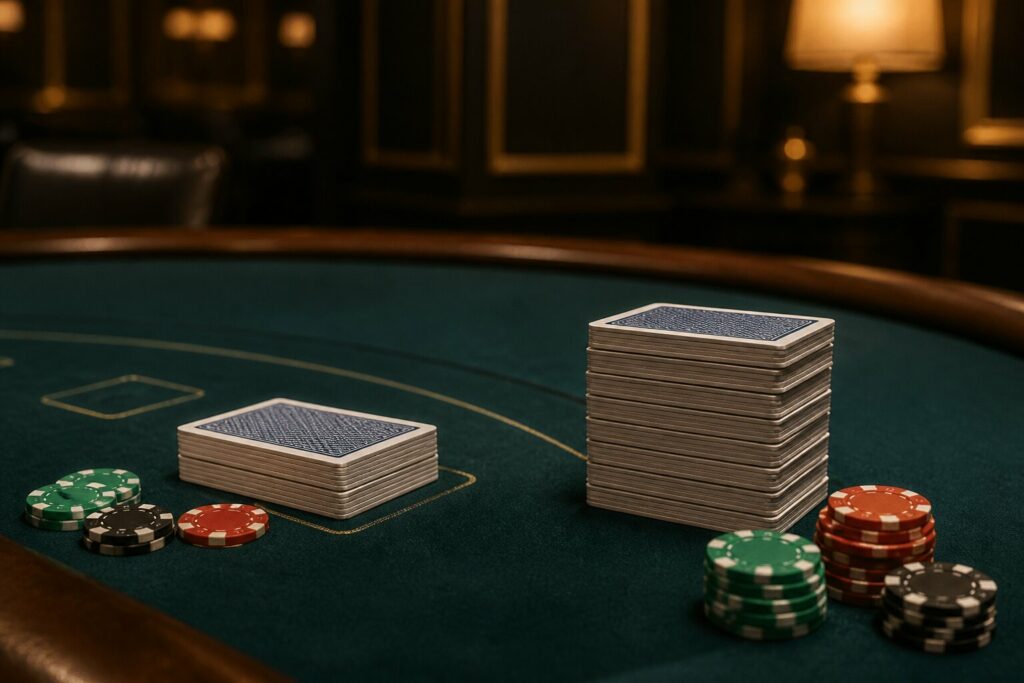
2 Deck vs 6 Deck Blackjack: How the Mechanics Differ in Play
Ever noticed a small sign at a blackjack table saying whether it’s two decks or six-deck, and wondered if it matters? That single detail changes more than the number of cards in the shoe; it alters how the game plays, how odds line up, and how easily a player can read the flow of cards.
The aim of the game stays the same, but the number of decks affects how frequently certain card combinations appear, how often the shoe is reshuffled, and how the table feels while you play. Below we unpack those differences in detail so you can pick a table with your eyes open.
What Are the Key Differences Between 2 Deck and 6 Deck Blackjack?
Two-deck and six-deck games differ in ways that affect both the practical experience and the statistical profile of the game. With two decks there are fewer cards to circulate, so individual cards have a bigger effect on what remains in the shoe. That tends to increase the incidence of natural blackjacks and makes card composition more volatile hand to hand. Six-deck shoes dilute the influence of any single card: outcomes are steadier and patterns harder to discern.
Deal speed and handling also diverge. Two-deck tables are frequently hand-dealt and reshuffled more often, which creates a more intimate pace and gives players better visibility of card movement. Six-deck games commonly use a dealing shoe and reshuffle less often, keeping the action smoother and faster. These differences shape not only the feel of the game but also how certain strategies perform.
With that groundwork on the table, it helps to look next at the concrete effect deck count has on the odds players face.
How Deck Count Impacts Blackjack Odds
Deck count produces measurable changes in the house edge and in the likelihood of specific outcomes. Fewer decks usually favour the player slightly: typical two-deck games under standard rules can produce a house edge in the region of 0.35% to 0.40%, while a comparable six-deck game often sits closer to 0.55%. Those figures may look small, but they become meaningful over many hands.
The chance of being dealt a natural blackjack is marginally higher with fewer decks. For instance, two decks yield a slightly greater percentage of opening blackjacks than six decks, which translates to a few more favourable outcomes across long sessions. Other probabilities shift too: the effectiveness of splitting, doubling and certain hand permutations is subtly affected by deck composition.
Rule variations can amplify or reduce these effects. A player-friendly rule set combined with two decks can be notably better for the player than a restrictive two-deck table, while generous six-deck rules can make that format more competitive. Understanding how deck count interacts with table rules is the next step in comparing games.
How Are Shuffling and Dealing Affected?
Shuffling frequency and dealing methods change with the shoe size. Two-deck games are reshuffled more often because the smaller shoe runs down quickly; this typically means reshuffles after around 60% to 75% of the cards have been dealt, creating more interruptions but also clearer short-term card composition. Dealers often handle cards by hand at these tables, which offers closer visibility into each deal.
Six-deck shoes go for longer before a shuffle, commonly reshuffling after 75% to 80% of the shoe has been used. That reduces interruptions and supports a brisker pace. Automated dealing shoes are usual in this format, improving speed and consistency but making it harder for a player to track specific cards.
Frequent reshuffling in smaller-shoe games can blunt attempts to capitalise on visible card patterns, while the extended runs of six-deck shoes maintain steady conditions for longer stretches. These operational differences also shape the atmosphere at the table, which leads naturally into how specific table rules further influence the house edge.
Table Rules and House Edge Explained
Table rules—how doubling, splitting, surrender and blackjack payouts are handled—work alongside deck count to determine the true house edge. Common rule variations include whether doubling is allowed on any two cards or limited to totals of 9, 10 or 11, whether doubling after a split is permitted, and whether aces may be re-split.
Blackjack payout is particularly important. The standard 3:2 payout remains the benchmark; any table offering lower payouts for a blackjack increases the house edge substantially. When combined with a larger shoe or restrictive doubling and splitting rules, those payout changes can shift the mathematics against the player more than deck count alone.
So when choosing a table, match deck size to the specific rules in play rather than treating deck count as the only factor. That helps frame which format is likely to be more favourable for your style of play.
Which Deck Format Is More Player-Friendly?
Determining which format is more player-friendly depends on a mix of house edge, table rules and the style of play a person prefers. Statistically, a two-deck game with favourable rules and a 3:2 payout is typically most advantageous. However, if a two-deck table imposes tight restrictions, a well-ruled six-deck game can be just as good or better for the player.
Beyond maths, the playing experience matters. Two-deck games often feel slower and more conversational, while six-deck games tend to be faster and more streamlined. Think about whether you prefer more time between hands and closer visibility of cards, or a quicker rhythm with fewer interruptions.
With those preferences in mind, the next section examines how one particular strategy — tracking card flow — is affected by deck format.
Comparing Card Counting Potential
Tracking the composition of the shoe is easier when fewer cards are in play because each removal alters the remaining mix more significantly. In two-deck games, counting systems like High-Low produce clearer signals, though frequent reshuffles will limit long-term advantage. In six-deck games the same signals are weaker and harder to maintain accurately, so counting tends to be far less impactful.
Casinos respond to any attempt to exploit card tracking with a range of measures intended to keep play fair and orderly. These include more frequent shuffles at small-shoe tables, continuous shuffling machines on larger shoes, and staff monitoring of unusual betting patterns. Venues can ask players to change seats or decline play if advantage strategies are suspected.
While tracking is more feasible with fewer decks, practical countermeasures and rule variations often neutralise much of that edge, so expectations should be realistic.
Choosing the Right Blackjack Table for You
Choosing a table comes down to matching rules, pace and stakes to personal preference. If a relaxed, visible game where card flow is easier to observe appeals, a two-deck table with fair rules and a 3:2 payout will usually be the best fit. If a faster tempo and fewer interruptions suit your style, a six-deck game with player-friendly rules can work well.
Check the specific rules at any table: doubling options, splitting policy, re-splitting aces and the blackjack payout are the most consequential details. Also confirm that the stakes match your comfort level and that you understand the tempo of play. Responsible play means setting sensible limits before you sit down and choosing a table that keeps the experience enjoyable.
Ultimately, the right choice balances solid rules with a deck format that matches how you like to play, and that final decision will shape both short-term enjoyment and longer-term outcomes.
Explore Casino Games at King Casino
Feel free to explore our collection of casino games at King Casino at your own pace. The experience is all about entertainment, so take things in your stride.
Getting started is simple: just set up an account, make a deposit and you’ll be ready to play. We look forward to seeing you enjoy your time with us.
**The information provided in this blog is intended for educational purposes and should not be construed as betting advice or a guarantee of success. Always gamble responsibly.