
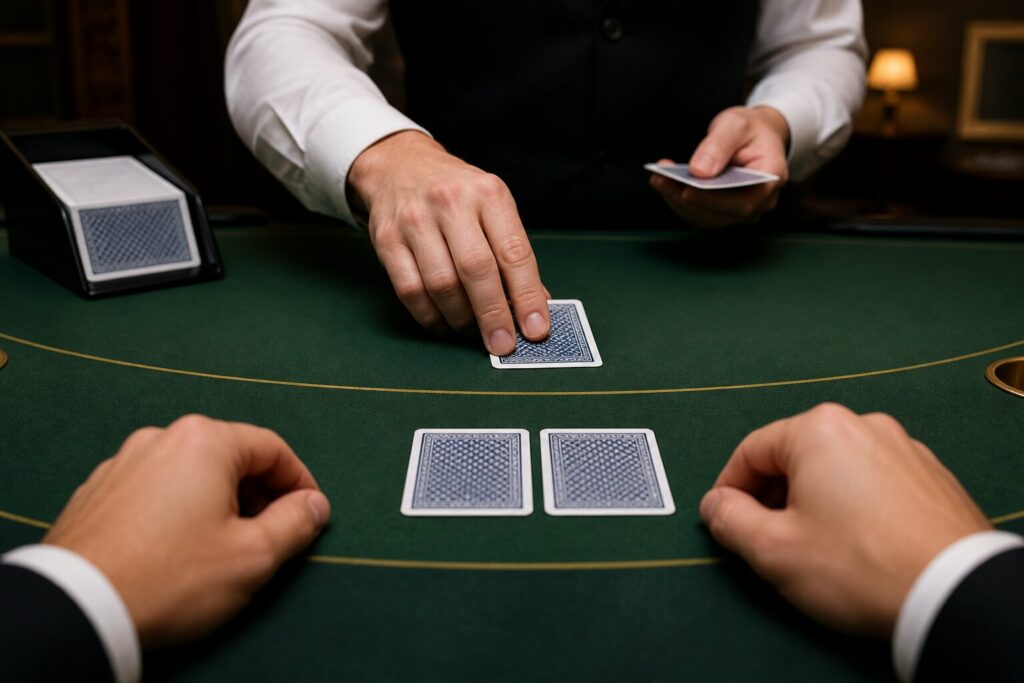
How Many Cards Do You Start With in Blackjack: Initial Deal Rules
Blackjack is one of the best-known casino games, played in venues and online. If you’re new to the table, knowing how the round begins — and how many cards each player gets — helps you follow the action and make informed choices.
This guide explains the initial deal, what a starting hand looks like, how different formats handle the deal, and what happens when a natural blackjack appears. Read on to understand the opening phase of play and how it shapes the rest of the round.
What Is the Standard Starting Hand in Blackjack?
The usual opening hand in blackjack is two cards dealt to each player. The dealer also receives two cards, though only one is normally visible until the dealer’s play begins.
Cards have set values that determine the starting total: 2–10 equal their face value, Jacks, Queens and Kings count as 10, and an Ace can count as either 1 or 11 depending on which suits the hand best. An Ace with any ten-value card makes a natural blackjack, an immediate 21 that is handled differently from ordinary hands.
The starting total matters because it sets the scene for later choices such as standing, taking another card, or splitting a pair. A hand of 12 to 16 is usually regarded as a borderline holding, while totals closer to 21 are stronger; an Ace gives flexibility because it can soften a hand (treating the Ace as 1 instead of 11) and reduce the risk of going bust. That flexibility often influences how players think about hits and stands as the round continues.
How Does the Initial Deal Work?
The initial deal follows a simple pattern to keep play organised. After bets are placed, cards are distributed around the table in a consistent order so every player knows what to expect.
Typically, each player receives one card face up, then the dealer takes a card. The dealer then gives each player a second card face up, and finally takes a second card, usually face down, known as the hole card. In shoe games with several decks the same order applies, though some casinos use continuous shuffling machines or automatic shufflers that change the logistics behind the scenes.
Dealing methods affect visibility and timing: the player’s cards are shown immediately so decisions can be based on known information, while the dealer’s concealed card keeps a degree of uncertainty until the dealer’s turn. This arrangement leads into how online and live versions of blackjack present the same basic deal in slightly different ways.
Do Rules Differ in Online and Live Blackjack?
The basic deal — two cards each, dealer showing one card — is the same whether play is digital or in person. What differs is how cards are produced and how many decks might be used.
Online blackjack typically uses random number generation to simulate a shuffled deck; the display and speed are driven by software, and games may use anything from a single deck to eight decks shuffled together. Live-dealer games use physical cards dealt on camera and usually mirror the rhythms of a casino table, with real shuffle procedures and human dealers. The number of decks, the use of a shoe, and whether the dealer checks for blackjack at certain times can vary between versions, and these rule choices influence house edge and strategy considerations.
Knowing the format helps set expectations for card distribution and pace, and it also affects how side options such as playing multiple hands at once are handled, which is explained next.
Blackjack Card Dealing: House vs Player Hands
Players and the dealer receive their opening cards under different visible conditions, and those visibility differences shape the decision-making on the table.
Each player’s two cards are usually displayed face up so the player and everyone else can see the hand’s value. The dealer too receives two cards, but only one is normally visible; the concealed card remains hidden until the dealer’s turn. This mixture of open and hidden information is central to play: players decide their approach while knowing their own full total but seeing only the dealer’s upcard.
The dealer must follow strict drawing rules once their hole card is revealed and play begins — typically drawing until reaching a specified minimum, such as 17. Those fixed rules remove discretion from the dealer’s choices and make the game’s mechanics predictable, which in turn affects how players weigh risky totals against safer ones. The next section looks at what occurs when a natural blackjack appears right at the start.
What If the Initial Deal Results in a Blackjack?
A natural blackjack — an Ace plus any ten-value card — is treated as the top opening hand and is resolved according to set procedures.
If a player has a natural and the dealer does not, that player’s round ends immediately and is settled at the normal blackjack payout. If the dealer also has a natural, the round is a push for that player and the stake is returned. If only the dealer has a natural, players without one lose their bets. Some games offer an insurance option when the dealer shows an Ace; this is a side wager against the dealer’s potential blackjack and is priced separately from the main stake.
Payout structures and whether insurance is offered can vary between game versions and operators, so being aware of those specifics for the table you are on helps understand how a natural blackjack will be handled in practice. With the main opening outcomes covered, the following section outlines how different blackjack variants treat the initial deal.
Variations in Initial Deal Across Blackjack Types
Different blackjack variants keep the core two-card start but adjust the timing or number of hands, producing subtle changes in how the opening deal plays out.
Classic Blackjack
Classic Blackjack begins with two cards for each participant. Players’ cards are shown face up while the dealer takes one card face up and one face down. This straightforward layout is the familiar casino pattern and underpins many standard strategy charts and expectations.
Because the dealer has one hidden card, players base most early decisions on the visible upcard and their own totals. The presence of that face down card also allows for an early check for naturals in some settings, which can end the round quickly if the dealer has blackjack. This predictability is one reason Classic Blackjack remains widely used at both land-based and online tables.
European Blackjack
European Blackjack changes the dealer’s timing: players receive their two cards first and the dealer is dealt only one upcard at the start. The dealer’s second card is not taken until players have completed their plays, which means there is no early check for blackjack. That timing alters certain strategic considerations and affects when insurance or similar options might be relevant.
Because the dealer does not take a second card until later, some player choices carry different risk profiles compared with Classic Blackjack. Players cannot be immediately pushed out by a dealer natural, so decisions on doubling or splitting can play out over a full sequence of actions. These timing differences are a key reason some players prefer European rules and why specific strategy charts exist for this variant.
Multi-Hand Blackjack
Multi-Hand Blackjack lets a player control more than one hand at once; each hand receives two cards on the initial deal and is then played out independently. The dealer handles their two cards as in Classic Blackjack. Playing multiple hands simultaneously changes how bankroll and risk are managed, since each hand wins or loses on its own terms.
Managing several hands at once raises both the potential for varied outcomes and the need for disciplined staking. Players must consider the cumulative exposure when choosing how much to bet on each hand and decide whether to apply the same strategy to all hands or to vary play according to the cards dealt. For many players the increased pace and complexity are part of the appeal, but it also demands careful attention throughout the round.
Each of these variants keeps the two-card opening as its foundation while varying timing or handling to offer different play experiences. Understanding those differences makes it easier to choose the version that best fits how you prefer to play.
Final note: the initial deal sets the strategic stage for the entire round, so recognising how many cards are dealt, which are visible, and how naturals are handled gives a clear picture of the opening mechanics and what follows at the table.
Keep in mind that rules can vary between casinos and tables, so checking the specific house rules before you play will ensure you know exactly how the initial deal and subsequent checks are handled.
Play Online Slots at King Casino
At King Casino, you’re always welcome to explore our site and discover an enjoyable casino experience at your own pace. We take pride in offering a place where things are hassle-free and relaxed, so you can settle in comfortably.
Getting set up is straightforward – just create an account, make your first deposit, and you’re ready to join the fun. We look forward to seeing you with us soon.
**The information provided in this blog is intended for educational purposes and should not be construed as betting advice or a guarantee of success. Always gamble responsibly.