
What Is a Standoff in Blackjack? Meaning, Rules & Game Outcomes
Blackjack is a staple at casinos across the UK, prized for its clear rules and decisions that matter. One outcome that can confuse players is the “standoff,” so this article explains what it is and how it affects your stake.
We will define the term, walk through how and when it happens, and look at any rule variations you might encounter. By the end you should feel confident about what happens to your bet when a standoff occurs and why it is treated the way it is.
What Does a Standoff Mean in Blackjack?
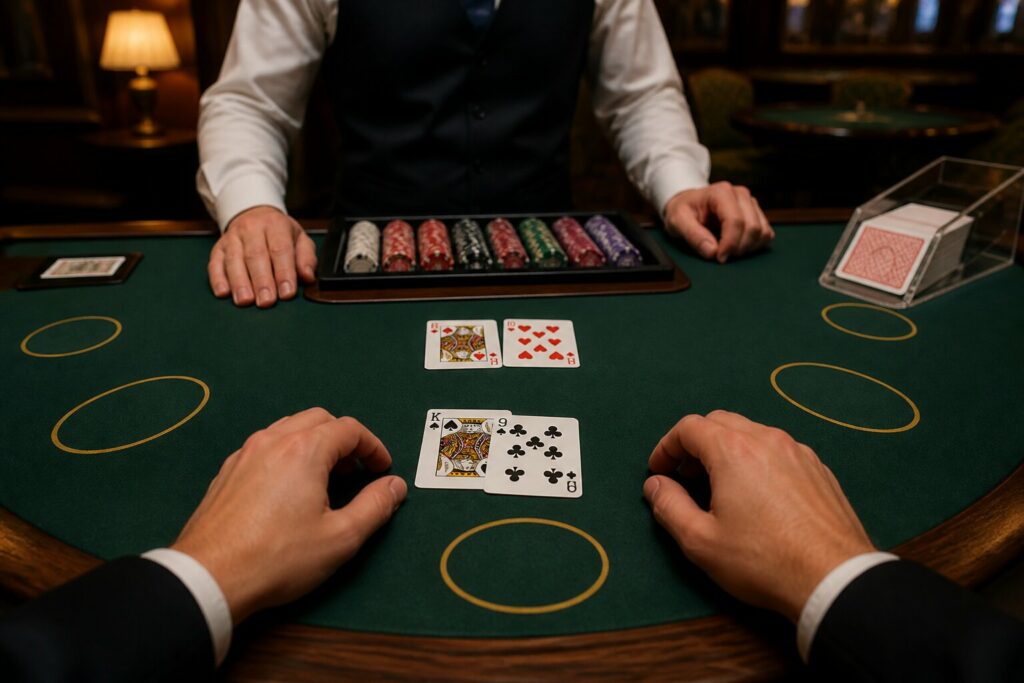
A standoff in blackjack is the same outcome commonly called a push: the player’s and dealer’s final hands have exactly the same value. Typical tied totals are 17, 18, 19 or 20, though any equal non-busting totals can produce a standoff.
When this happens the round ends neutrally. Your original bet is returned and there is no win or loss recorded for that hand. The exchange is handled automatically by the table or the casino system, so it does not require any action from the player.
This neutral result matters because it sits alongside the two other possible outcomes—winning or losing—and influences how a session’s net result develops over multiple hands.
How Does a Standoff Occur During Gameplay?
A standoff is resolved after both the player and the dealer complete their turns. The dealer follows preset rules for drawing cards, and when both hands are finalised the totals are compared. If they match and neither hand has exceeded 21, the round is a standoff.
It makes no difference how either hand arrived at that total. Whether the player stood after two cards or reached the number after several hits, only the final values determine the result. The simplicity of this comparison is one reason standoffs are straightforward to apply at the table.
If a player and the dealer both have blackjack (an Ace plus a 10-value card), many games treat that as a push as well, though some variations handle blackjacks slightly differently. Check the table rules for specifics on blackjack-versus-blackjack outcomes.
Common Rules Governing Standoffs
Casinos publish the rules that govern how ties are handled for each table or digital game. These rules clarify whether a tie with a blackjack is treated like other ties, how side bets interact with standoffs, and any differences in payout structure for special variants.
Across the industry, a standoff simply returns the stake to the player, but some variants introduce subtle changes for side bets or for blackjack-specific ties. These differences are usually documented in the game rules, so taking a moment to review them before playing helps you avoid surprises.
Where regulatory oversight applies, operators must make such rules accessible and clear so players can confirm how outcomes will be settled.
Impact of Different Casino Rules on Standoffs
Variants and side bets can alter how a tie is treated. For example, a side market might continue to pay regardless of the main hand result, or some versions award different handling to a blackjack tie compared with a tie on a non-blackjack total. These distinctions can affect the expected return from particular bets.
Understanding the table-specific rules allows you to anticipate those situations and interpret results correctly when they occur.
What Happens to Your Bet in a Standoff?
When a standoff occurs, the player’s stake is returned intact. No winnings are paid and no losses are recorded for that hand.
In live games, the dealer will announce the push and return the chips to you. In digital play the stake is credited back to your balance immediately, usually with a notification or on-screen update.
In practice this means:
- your original stake is restored,
- you do not receive any winnings for that round,
- no loss is taken from your balance for that hand.
This outcome does not alter your bankroll beyond restoring the amount you risked for that round. Your overall balance will be the same as before you placed the bet, so you have neither won nor lost on that particular hand.
After the returned stake appears, you are free to place a fresh bet if you wish to continue playing. You can choose to bet the same amount, change your stake, or sit out for a while; the choice is yours.
Are Standoffs Good or Bad for Players?
A standoff is neither beneficial nor harmful in itself; it simply pauses movement of funds for that hand. Over a session, pushes can have a modest effect on results because they reduce the number of hands that settle as wins or losses, but the result is neutral for each round where it happens. In statistical terms, pushes remove that hand from affecting your short-term variance: neither increasing nor decreasing your expected value for that particular round.
Players sometimes view frequent standoffs as frustrating because they interrupt winning runs or delay recovery from losses. That interruption can feel like lost momentum, especially during a streak where you expected to convert more hands into settled outcomes. Equally, a string of pushes can slow the rate at which you rebuild a depleted bankroll, which matters for session planning and staking decisions.
At the same time, a push can be preferable to a loss since it preserves your stake for another hand. For players practising disciplined bankroll management, pushes can help limit immediate downside and give more opportunities to play subsequent hands. Emotionally, a push often produces less regret than a loss, though it may still be disappointing if you were confident in your play.
Overall, whether standoffs are seen as good or bad depends on an individual player’s goals and perspective: some value the preservation of funds and reduced variance, while others dislike the delay to resolution and the interruption of momentum. Remember to play responsibly and consider how pauses in action fit your broader session plan and betting limits.
Standoff vs Push: Are They the Same?
The terms standoff and push describe the same situation: equal final totals between player and dealer that result in the original bet being returned. In both cases there is no win and no loss on that particular hand, and your stake is simply handed back.
Usage of the two words varies by region and by operator. In many rulebooks and casino guides the word push is more commonly used, while some venues and rule sets prefer standoff. This is a matter of wording rather than of substance, so the practical outcome does not change.
If you see either term on a table sign, in the rules or in help text, treat them as equivalent. Typical contexts where you might encounter one term or the other include:
- Casino rulebooks and printed table signage.
- Online operator help pages and game descriptions.
- Regional guides or local gaming terminology.
Terminology does not affect how the hand is settled or what happens to your stake. When totals match, expect the same result regardless of whether the rules say standoff or push.
Myths About Standoffs in Blackjack
Several misconceptions surround standoffs. One common belief is that a standoff changes the probability of future hands. In truth, the rules that determine whether a hand is a win, loss or push remain the same from one deal to the next, and outcomes are best considered in terms of long-run probabilities rather than guarantees for any single session.
Another myth claims players can force or avoid pushes by particular choices. While a player’s decisions do alter the chance of a tie in the specific hand being played, there is no strategy that guarantees or prevents pushes across many rounds. Risk decisions should be made to suit your own goals and bankroll, not on the expectation of eliminating or engineering standoffs.
A related confusion is treating repeated pushes as signalling a pattern that must reverse. People sometimes feel that a run of ties means the next hand is “due” to break the pattern, or conversely that ties will continue. Neither belief is reliable. Ties are one of the standard possible outcomes and, aside from the normal mathematical effects of removed cards in shoe games, do not provide short-term predictability beyond the usual probabilities for hand totals.
Keep in mind that probability statements describe tendencies over many hands, not certainties in the short term. Play responsibly, set limits, and remember that no approach can turn chance into a guarantee.
How to Deal With a Standoff as a Player
There is no extra procedure for the player when a standoff happens. Your original stake is returned and play continues as normal. You are free to take that returned stake away, leave it on the table, or use it to place a new bet in the next round.
If you wish to continue, placing a new wager moves the action forward. If you do not want to continue, you may leave the table with your remaining balance or cash out at the designated point. Any progressive or side bets that depend on an outright outcome may have specific rules for ties, so check those separately.
If anything about how standoffs are settled seems unclear during play, consult the table rules or ask floor staff or support. Operators are required to make outcome handling transparent, and staff can clarify any table-specific treatment of ties or related bets.
If you still have questions after speaking to staff, you can raise the matter with the operator’s formal complaints or support channels. Keeping records such as your tickets or hand histories can help resolve any dispute quickly and fairly.
Summary of Standoffs in Blackjack
Standoffs, or pushes, are a routine and neutral result in blackjack where player and dealer finish with identical non-busting totals. The stake is returned and the round ends without a win or loss. While some table variants and side bets introduce specific handling, the basic outcome remains the same across standard games.
Knowing how standoffs are handled helps you interpret your session balance and avoids confusion at the table. If you ever need guidance about a particular game, check the published rules or ask for clarification from the operator before you play.
**The information provided in this blog is intended for educational purposes and should not be construed as betting advice or a guarantee of success. Always gamble responsibly.