

Roulette: Odds of Red X Times in a Row & Probability Guide
Ever wondered how often red can land again and again at the roulette table? Whether you are curious about a single spin or a long streak, understanding the actual probabilities helps you set clear expectations before you play.
This guide walks through simple formulas, worked examples, and what they mean for real play. You will see how different wheels shape the numbers, how to read streaks in context, and why patterns are less predictive than they seem.
If you enjoy the maths behind roulette or want a clearer view of risk and reward, you are in the right place.
How Roulette Wheels Affect the Odds
Roulette wheels are not all the same, and the layout matters for the probability of red.
- European roulette has 37 pockets in total. There are 18 red, 18 black, and a single zero. The probability of red on any single spin is 18 out of 37, which is about 48.65 percent.
- American roulette has 38 pockets. There are 18 red, 18 black, and two green zeros. The probability of red is 18 out of 38, about 47.37 percent.
Even-money bets such as red or black pay 1:1, but the zero pockets mean the chance of winning is slightly below 50 percent. That small gap is the house edge. On European wheels it is about 2.7 percent. On American wheels it is about 5.26 percent.
Now that the base chance is clear, it is easy to extend it to streaks.
The Probability of Red X Times in a Row
Streaks are simply repeated independent outcomes. If the probability of red on a single spin is p, then the probability of red k times in a row is p to the power of k.
For European roulette, p = 18/37. For American roulette, p = 18/38. Here are some useful benchmarks to show how quickly the numbers shrink as k grows:
- European wheel: 1 red ≈ 48.65%, 2 in a row ≈ 23.67%, 3 in a row ≈ 11.50%, 5 in a row ≈ 2.72%, 10 in a row ≈ 0.074%
- American wheel: 1 red ≈ 47.37%, 2 in a row ≈ 22.44%, 3 in a row ≈ 10.69%, 5 in a row ≈ 2.43%, 10 in a row ≈ 0.059%
These figures apply to any specific run of consecutive reds starting from a chosen spin. Over a long session, there are many possible starting points, which is why streaks sometimes appear even though each one is individually unlikely.
Streaks, Independence, and Why Patterns Mislead
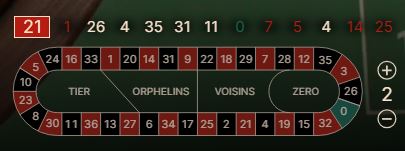
Each spin of a fair wheel is independent. That means previous results do not change the probability of the next spin. A long run of red does not make black more likely next time, and it does not make red more likely either. The chance on the next spin remains the same as it always was for that wheel.
It can help to think in sequences rather than colours. The probability of any particular 10-spin pattern on a European wheel, such as RRRRRRRRRR or RBRBRBRBRB, is exactly the same once you count the reds and blacks correctly and include the chance of hitting zero. Streaks feel special because they stand out in memory, but they are part of normal variance.
If you are curious about how often streaks might show up in a session, there is a simple guide. In a sequence of N spins, the expected number of starting points that produce k reds in a row is roughly (N − k + 1) multiplied by p to the power of k. That does not predict when a streak will occur. It just shows that longer sessions create more opportunities for rare runs to appear.
Putting the Numbers into Context
Knowing the single-spin probabilities helps to interpret common betting choices. Red or black is an even-money bet, but the presence of zero means you will not win on just over half the spins in the long run. Streaks do not change that. Strategies that raise or lower stakes after wins or losses do not alter the underlying odds either, because the probability on the next spin is unchanged.
Wheel choice does matter. The European layout gives a higher single-spin chance of red and a lower house edge than the American layout. Over time, that smaller edge means a slower expected loss rate per pound staked.
If you want to test the maths yourself, use p = 18/37 on a European wheel or p = 18/38 on an American wheel, then raise p to the number of consecutive reds you have in mind. The same idea works for black. Just remember that zero is always in play.
A Quick Word on Staying in Control
Roulette is designed so the house edge applies over time, regardless of patterns or stake adjustments. If you choose to play, set a budget you are comfortable with, take breaks, and use the safer gambling tools available, such as deposit limits and reality checks. If the fun stops, stop.
If you would like to explore roulette with these probabilities in mind, you can browse our games at King Casino and set limits before you start. Understanding the numbers helps you keep play measured and enjoyable.
*All values (Bet Levels, Maximum Wins, etc.) mentioned in relation to these slot games are subject to change at any time. Game features mentioned may not be available in some jurisdictions.
**The information provided in this blog is intended for educational purposes and should not be construed as betting advice or a guarantee of success. Always gamble responsibly.