
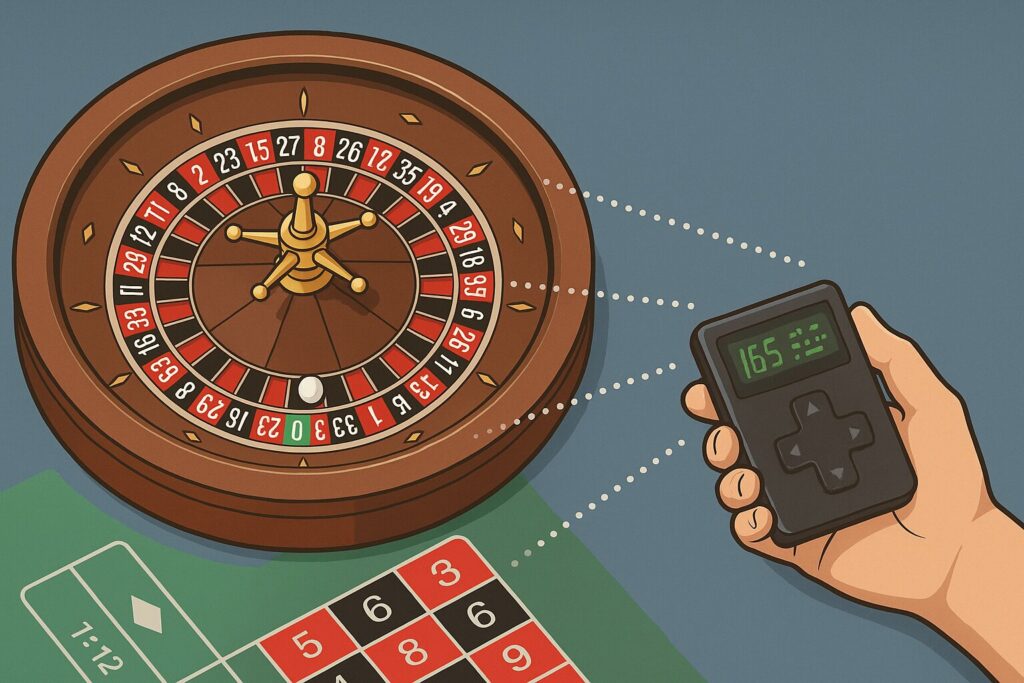
Roulette Prediction Computer Device: How Does a Roulette Computer Work?
Ever wondered whether a small gadget can take the mystery out of roulette? Roulette prediction computers have captured the imagination of casino visitors and tech fans alike, promising to turn timing and observation into an edge.
Those claims deserve careful scrutiny. Modern, well-maintained wheels and the way games are operated mean no device can remove the house advantage or guarantee a winning outcome. This article explains how these devices are said to work, the technology behind them, the legal position in the UK, and the practical risks involved so you can separate fact from fiction.
If you want to understand what’s technically possible and what isn’t before making any decisions, read on — the next sections take a closer look, step by step.
What Is a Roulette Prediction Computer?
A roulette prediction computer is a compact electronic tool intended to estimate where the ball might come to rest on a wheel. The basic idea is that by timing the rotation of the wheel and the ball and running quick calculations, the device narrows down likely sections or numbers.
Users typically hide these devices on their person and record timing information by pressing a button or using a sensor while watching spins. The device processes the inputs and returns a short result, sometimes communicated by a vibration or a small visual cue.
Those descriptions explain the concept, but it’s important to be clear: these devices are not permitted in licensed UK casinos. Possession or use is treated as cheating and carries significant consequences.
How Does a Roulette Computer Function in Practice?
In practice, a prediction device depends on rapid observation and fast calculation. During play, a user records the interval of the wheel’s rotations or the ball’s passes and feeds that timing into the device. The processor then estimates the ball’s deceleration and the wheel’s angular velocity to suggest probable locations.
Some devices aim to compensate for variables such as initial ball speed or wheel friction, but real-world factors create uncertainty. Slight differences in the ball’s bounce, microscopic wear on pockets, or a dealer’s varying launch can all alter outcomes in ways the device cannot fully predict.
Casinos take a very dim view of such equipment. Staff and security teams monitor for unusual behaviour, and using a device risks immediate removal, bans and legal action. For players, the practical risk profile is high and the claimed benefits are not reliable.
What Technology Is Used Inside Roulette Computers?
Internally, these devices typically include a small microprocessor, a timing input (button or sensor), and a simple output mechanism such as a vibration motor or tiny display. The processor runs a basic physics model, combining timings to estimate where the ball might slow and fall into the wheel’s pockets.
Some versions attempt to improve accuracy with more sophisticated sensors or faster processors, but the core components remain similar: timing, calculation and discreet signalling. The limitations of the measurements and the chaotic elements of each spin restrict the usefulness of the results.
Availability of such devices is limited and their use in regulated venues is prohibited. That restriction is as much about preserving fair play as it is about enforcement; casinos routinely check for devices or anomalous play patterns.
Are Roulette Prediction Devices Legal in the UK?
Under the Gambling Act 2005 and the regulator’s rules, using or possessing a device intended to influence or predict the outcome of gambling is illegal in licensed venues. The legal framework treats such items as tools for cheating and seeks to protect the integrity of games and the safety of customers.
This prohibition covers a range of conduct, including possession, use, or attempted use of devices designed to affect play. It also extends to equipment or software intended to give an unfair advantage, whether obvious or concealed.
Consequences for being found with a prediction device can include:
- immediate removal from the venue,
- lifetime bans from that premises and potentially others if operators share details,
- seizure of the device and evidence,
- criminal proceedings which may result in fines or other penalties, and
- civil action by operators where relevant.
Venues are required to enforce these rules and may pass information to other licensed operators or to the Gambling Commission. That can lead to restrictions on access across multiple venues and affect future licensing checks.
Understanding the law and the potential penalties is essential. If you value continued access to licensed gambling, it is safest to avoid any contravening equipment or behaviour. If you are unsure about what is allowed, speak to venue staff or consult official guidance from the Gambling Commission.
Can a Computer Really Predict Roulette Outcomes?
Roulette outcomes are governed by many interacting physical factors. While a device can use timing to produce a probabilistic estimate, it cannot account for every micro-variation in ball bounce, pocket geometry or dealer action. Those small differences have an outsized effect on where the ball finally settles.
Practical tests and independent analyses show that any improvement in prediction is marginal and highly dependent on unusually favourable conditions. Even then, the house edge remains, so predicted advantages do not translate into guaranteed profit.
Framing roulette as a form of entertainment, and treating any claimed method with scepticism, helps prevent unrealistic expectations or risky behaviour.
Common Myths About Roulette Computers
Many popular stories exaggerate what these devices can do. A persistent myth is that they can ensure steady wins. In reality, no device can remove the structural advantage built into the game.
Another misconception is that devices are undetectable. Casinos use trained staff and monitoring systems that make discreet use increasingly risky. There is also a tendency in folklore to believe that minor technical tweaks suddenly make a device lawful or infallible; legally and practically, that is not the case.
These myths often mix selective anecdotes with technical-sounding language. Looking at the full picture—technical limits, legal risk and operational countermeasures—gives a more realistic understanding.
Potential Risks and Downsides of Using a Prediction Device
Beyond the legal penalties, using such a device carries several practical downsides. The technology is often unreliable, detection methods are improving, and operators take a firm stance against anything perceived as an attempt to gain an unfair advantage.
If detected, players risk:
- losing funds associated with the incident, including seized winnings and deposits
- being blacklisted by multiple operators, which can prevent future play
- facing criminal charges or civil action, depending on the scale and circumstances of the offence
There is also reputational damage to consider. Accusations of cheating can harm employment prospects, professional licences, or social standing, and such effects can persist even without a legal conviction.
Financially, the promised edge rarely materialises in a reliable way, so users may lose more than they gain. Unexpected costs, fees, and the psychological impact of chasing losses can exacerbate the harm.
Given these risks, relying on standard, lawful play and managing stakes sensibly is a far safer approach. Responsible bankroll management and understanding the odds will protect both funds and personal reputation.
How Casinos Detect and Prevent the Use of Prediction Devices
Casinos use a combination of monitoring, experienced personnel and technical tools to defend fair play.
Advanced Surveillance
High-quality CCTV systems and continuous monitoring let staff observe players’ behaviour and spot patterns that could indicate tampering or the use of hidden devices.
Experienced Staff
Floor staff and surveillance teams are trained to recognise suspicious behaviour and respond quickly. Their experience helps them detect actions that automated systems might not flag.
Technical Countermeasures
Security teams sometimes use signal detection equipment and random checks to find concealed electronics. Regular inspections and maintenance of equipment also reduce opportunities for devices to gain any practical advantage.
These safeguards support a level playing field for all guests. We invest in these measures and follow regulatory guidance to protect customers and keep games fair.
If you have questions about how we operate or about gaming rules, our team is happy to help. Playing within the law and venue rules keeps the experience safe and fair for everyone.
**The information provided in this blog is intended for educational purposes and should not be construed as betting advice or a guarantee of success. Always gamble responsibly.