What Does “Cooler” Mean in Poker: How Do These Tough Hands Happen?
Picture this: you’re at the poker table with a monster hand that seems almost unbeatable. The tension mounts as you place your bets, certain you’ve made all the right moves. But then the cards are flipped and your brilliant hand is outdone by an even stronger one.
Every poker player — from beginners to seasoned regulars — knows that crushing feeling of running into a “cooler.” It’s the moment when winning looks inevitable, only for the rug to be pulled from under you by a hand clash you couldn’t reasonably have avoided. Understanding what causes coolers helps you stay calm and make better long-term decisions at the table.
Below, we define coolers clearly, explore how they form, examine common examples and their psychological impact, and consider how they play out differently in cash games and tournaments. Read on to see how these tough hands happen and how players typically respond.
Defining a “Cooler” in Poker
A “cooler” is a showdown in which two players each hold very strong hands, but one is inevitably beaten by the other. What makes a cooler distinctive is that folding would be almost unthinkable for either player — the hands involved are so strong that putting the chips in is the natural choice.
This differs from a bad beat, where a superior hand is outdrawn by a weaker one that makes an unlikely comeback on the turn or river. In a cooler, both hands are premium from the outset or become so as the board develops, and there’s little or no action a player could have taken to avoid the loss.
Typical cooler examples include one full house losing to a higher full house, a lower set facing a higher set, or a high flush being outrun by an even higher flush. These outcomes arise from the combinational nature of the deck and the way community cards interact with hole cards, rather than from poor play.
Such hands are part of poker’s variance; they remind players that even correct decisions can sometimes produce unfavourable results. Next, we’ll look at how these matchups typically develop at the table.
How Do Coolers Occur at the Poker Table?
Coolers form when community cards combine with players’ hole cards to create multiple very strong hands simultaneously. In Texas Hold’em, for instance, the shared board often allows several powerful hands to coexist, and that overlap is where coolers most frequently happen.
A common pathway is when both players begin with pocket pairs and the board gives each a set. One might hold queens and the other kings; if the flop includes both ranks, both make three of a kind but the higher set wins. Other routes include both players completing straights or flushes on the river but one having the higher version.
Because the hands in a cooler are reasonable to play aggressively, typical betting patterns and pot sizes push the action to a showdown. Skill can shape many decisions during a hand, such as bet sizing and position play, but it can’t change the specific card combinations that end up at showdown.
Understanding these mechanics helps you recognise when a hand is a genuine cooler rather than a result of misjudgement, which in turn makes it easier to manage the emotional fallout. With that in mind, the next section lists the most frequent cooler situations so you can spot them when they occur.
Common Situations That Lead to Coolers
Coolers tend to appear where both hands are so strong that folding becomes almost impossible. Below are the frequent scenarios that produce these unavoidable clashes.
What Are the Most Frequent Cooler Scenarios?
- Set over set: Two players have different pocket pairs and the board pairs both ranks, producing competing three-of-a-kinds.
- Full house versus higher full house: One player’s full house is outranked by an opponent’s higher full house because the board and hole cards combine that way.
- Flush versus higher flush: Both players complete a flush but one uses a higher-value card to make the superior flush.
- Straight over straight: Both players hold straights but one straight is higher, often because one player has a higher connected combination.
Each of these examples illustrates hands that most players would naturally play to the end, which is why coolers so often reach showdowns. Scenarios involving overlapping draws or mutually strong holdings are particularly prone to producing large pots that end in a cooler.
Having outlined these typical patterns, it’s worth considering how encountering such hands affects players mentally and behaviourally at the table.
How Do Coolers Differ from Bad Beats?
Coolers are distinct from bad beats because they typically involve two very strong hands rather than a superior hand being outdrawn by a much weaker holding. In a bad beat, an underdog that should reasonably have been folded catches up by the river; in a cooler, both hands are justifiably strong and very hard to fold at each decision point.
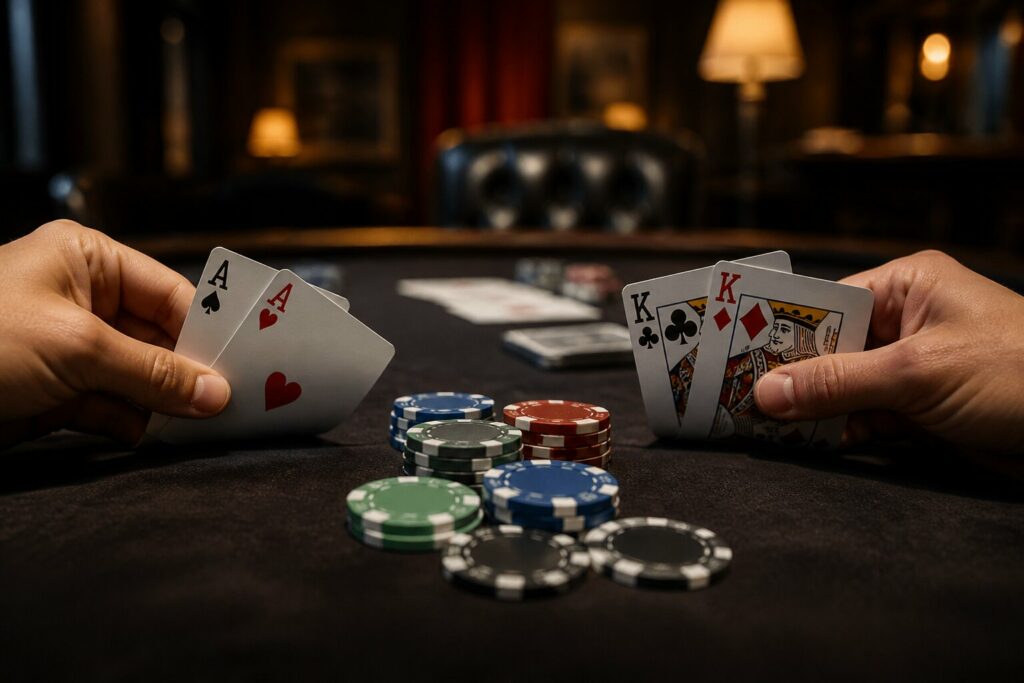
For instance, being dealt aces and losing to an opponent’s pocket kings that improve to a set is a cooler if the action and board make the set unavoidable to call. Conversely, losing aces to a weak starting hand that happens to pair up twice on later streets would be classed as a bad beat. This distinction matters because it clarifies whether a loss was a consequence of variance inherent to the deal, or an upset by unlikely draw outcomes.
Having distinguished the two, the next section looks at the real-world impact coolers have on poker players at the table.
Impact of Coolers on Poker Players
A cooler can sting because it often follows correct decisions and sound play. Players commonly report immediate frustration, diminished concentration, or second-guessing after a particularly harsh cooler. Over the course of a session, several such losses can erode discipline and encourage impulsive moves, which tend to compound losses.
Emotionally, coolers test a player’s resilience. Productive responses involve acknowledging the hand as part of the game’s variance, taking a short break if emotions rise, and returning with the same strategy rather than reacting out of frustration. Financially, managing stake sizes and keeping a clear bankroll plan prevents one cooler from having an outsized effect on overall play.
If poker begins to affect mood or behaviour outside the game, seeking confidential support is important; GamCare and similar services exist for this reason. With emotional tools in place, players are better prepared to continue playing rationally — and to face the statistical realities that lead to certain hands being unavoidable. Next, we consider whether there are practical ways to reduce the frequency or cost of coolers.
Can Coolers Be Avoided or Minimized?
Coolers cannot be entirely avoided because they arise from the mathematical combinations of the deck. Even the strongest strategic approach can’t change the probability that two premium hands will clash. What players can control, however, is how those clashes are managed to limit harm over the long run.
Playing consistently, maintaining discipline after a tough loss, and controlling bet sizes help reduce the financial impact of a single cooler. For example, avoiding unnecessarily large all-in confrontations when stacks and pot odds don’t justify them can limit exposure, but this judgement must be balanced against the hands that merit aggression. Bankroll management and a steady mindset ensure that coolers remain isolated incidents rather than triggers for erratic behaviour.
Those measures won’t stop coolers from occurring, but they make the consequences easier to bear and help preserve the ability to play well in subsequent hands. The way coolers influence outcomes also differs depending on whether you’re in a cash game or a tournament, which is worth exploring next.
Cooler Hands in Cash Games vs. Tournaments
Coolers turn out differently in cash games and tournaments because the value and meaning of chips change between formats. In cash games, chips equate to real money and players can rebuy. A big cooler that wipes out a stack means a financial loss but not necessarily the end of play; a player may rebuy and continue. This flexibility tends to reduce the strategic pressure around any single cooler.
In tournaments, chips represent tournament life and there is usually no rebuy. A cooler that eliminates a player or leaves them with a tiny stack carries added pressure because the match stakes change dramatically. Decisions in tournaments are therefore shaped more by survival considerations: avoiding marginal spots and judging risk relative to stack depth, tournament stage and payout structure become more important.
Both formats see coolers, but their consequences and how players respond vary because of those structural differences. Recognising that helps adjust expectations and strategy depending on whether the immediate goal is preserving cash or advancing through a tournament field.
Whether you’re playing cash or tournament poker, coolers are part of the game’s variability — they test patience, bankroll planning and emotional control, but they needn’t derail a session when handled sensibly.
Play Online Casino Games at King Casino
Feel free to enjoy the entertainment experience we offer at King Casino in your own way and at your own pace. Take a moment to explore all that we have created for our players and see what makes playing with us so enjoyable.
Getting started is straightforward: simply create an account, make a deposit and you can begin your adventure with us. We look forward to having you as part of our community.
**The information provided in this blog is intended for educational purposes and should not be construed as betting advice or a guarantee of success. Always gamble responsibly.