
Bad Beat in Poker: How It Happens and a Simple Example
Anyone who’s spent time at the poker table knows the sting of a hand gone horribly wrong. You make the best plays, get your chips in with the strongest hand, and then a single card on the river changes everything. That gut-punch is familiar to players at every level.
This scenario has a name: the bad beat. It describes those moments when a near-certain win slips away because the later community cards produce an unlikely turnaround. Understanding what a bad beat is, and how it happens, helps you keep perspective when the game takes an unexpected turn.
Read on to see what defines a bad beat, why it occurs, how it affects players, and what a typical example looks like.
What Is a Bad Beat in Poker?
A bad beat occurs when a player with a very strong hand loses to an opponent who started with a much weaker holding but completes a far better combination as the community cards are revealed. It’s a widely used term around poker tables to sum up those dramatic reversals where a hand that seemed almost guaranteed to win is overtaken at the last moment.
For example, holding a pair of aces while an opponent has a pair of sevens puts you in a commanding position. If the final community card gives the opponent a three of a kind, however, the result flips. Similarly, an apparently unbeatable straight or flush can be outdone on the river by a full house or four of a kind. These outcomes are exactly what players mean by a bad beat.
This definition leads naturally into the mechanics behind such reversals, which are explained next.
Why Do Bad Beats Occur?
Bad beats happen because poker combines skillful decision-making with the inherent randomness of shuffled cards. Skill helps you interpret the situation, manage the pot and choose when to commit chips, but the ordering of unseen cards can still produce dramatic changes after each betting round.
Key factors include the turn and the river — the two community cards revealed late in a hand. A holding that dominates through the flop and the turn may still be vulnerable if an opponent needs just one particular card to complete a stronger hand. For instance, a player holding a set of kings may be ahead until an opponent completes a flush on the river, despite that outcome being statistically unlikely at earlier stages.
Probability underpins every hand, so even very low-probability events can and do occur. That unpredictability is part of what makes poker tense and absorbing, and it is also why strong play focuses on managing risk rather than guaranteeing success.
How Does a Bad Beat Affect Poker Players?
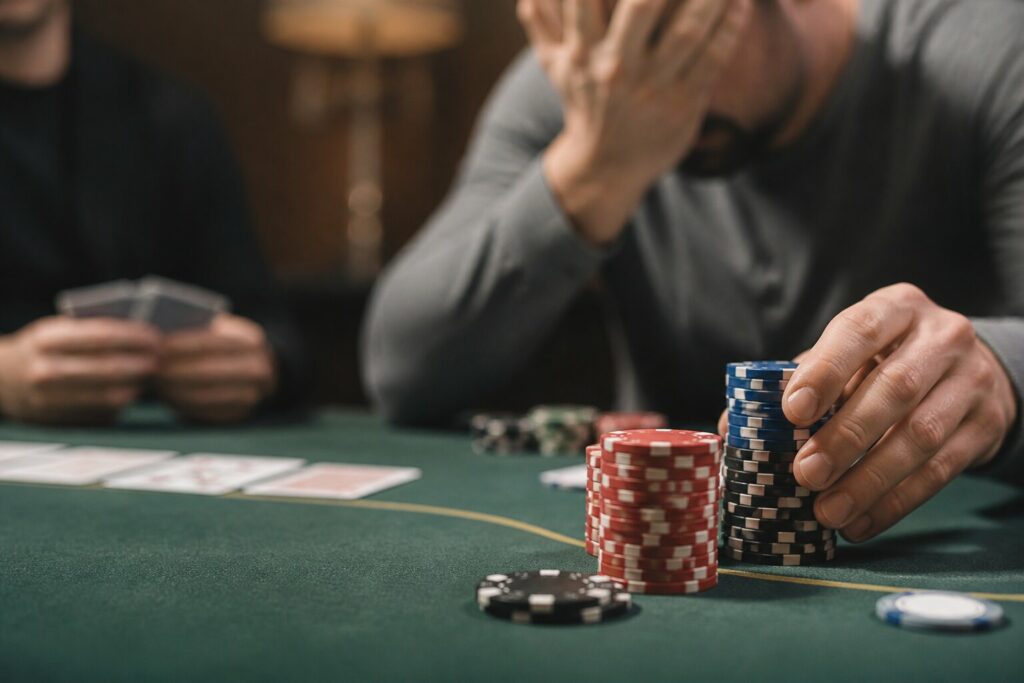
A bad beat can provoke strong emotions. Frustration and surprise at a sudden reversal are common, and for some players these feelings lead to what is known as tilt, where emotional reactions drive poorer decisions and riskier betting.
When tilt takes hold, a single bad result can escalate into a series of mistakes. That makes emotional control an essential skill; experienced players learn to step back, reassess and avoid letting one hand determine the rest of their session. Keeping a measured approach helps maintain consistent, long-term play and protects both bankroll and enjoyment.
Emotional responses also affect the atmosphere at the table, influencing how opponents perceive you and how future hands are played. With that in mind, the next section looks at how to spot a bad beat as it happens and how others around the table typically react.
Recognising a Bad Beat: Key Signs at the Table
When a bad beat occurs, the reactions tend to be visible. A losing player may show shock or disbelief, lean back, or breathe out sharply. Hands may be pushed away more forcefully than usual, and there can be a brief, stunned silence as everyone registers the unlikely final card.
Players sometimes express themselves aloud with short exclamations or dry humour; other times the reaction is quieter but just as telling. Observers often exchange looks of sympathy or surprise, particularly if the turnaround came on an exceptionally rare card.
These table cues are part of the social fabric of poker and help to remind everyone that no matter how confident a read or hand may have been, the deal is not complete until the final card is dealt. Ahead lies a closer look at common misconceptions that surround bad beats.
Common Misconceptions About Bad Beats
A number of myths surround bad beats. One is that they indicate the game is rigged or that certain players are being singled out. In truth, bad beats are the natural result of card distribution over many hands; they happen to everyone and do not imply malfeasance.
Another misconception is that specific betting systems or styles can eliminate bad beats. While good strategy reduces the frequency of getting caught in marginal spots, no approach removes the possibility of an opponent completing a superior hand on a later street. Similarly, there are no reliable signs that a bad beat is about to occur; the defining feature is the arrival of particular community cards, which cannot be predicted.
Understanding these points helps keep expectations realistic and makes it easier to focus on the aspects of the game that are under a player’s control, such as bet sizing and table dynamics. The next section gives a concrete example so the idea of a bad beat becomes tangible.
A Simple Example of a Bad Beat in Poker
Picture a Texas Hold’em hand where you start with pocket aces and an opponent holds pocket jacks. Pre-flop, your aces are heavily favoured, and both players go all-in before any community cards appear. The flop comes 4 clubs, 7 spades, 2 diamonds; the turn is 8 clubs. Your aces remain ahead.
Then the river is the jack of spades. That single card gives your opponent three of a kind, overtaking your pair of aces and winning the pot. You had the superior hand from the start through to the river, but the final community card altered the outcome.
This example shows how a hand that looks dominant can still be vulnerable to a late-arriving combination. With that in mind, the closing section considers practical ways to respond when these situations arise.
Coping With Bad Beats
Dealing with a bad beat is largely about perspective and practical safeguards. Short breaks from the table help restore focus and calm, while pre-set limits on time and money prevent one result from having outsized consequences. Discussing the hand with friends or fellow players can also offer reassurance and a clearer reading of whether decisions made were sound.
Keeping play enjoyable remains the best guide; when the primary aim is entertainment rather than chasing outcomes, it becomes simpler to accept the ups and downs that are part of the game. Maintaining control over emotion and resources ensures poker stays a sustainable pastime, and that a single bad beat does not define your session.
Ultimately, bad beats are an inevitable part of poker’s mix of decision-making and randomness, and how a player responds to them often matters more than the hand itself.
Play Casino Games at King Casino
Feel free to take a look around our site, where you can enjoy an entertaining experience playing a wide range of casino games with us. There is something for nearly everyone to explore on our site.
It is easy to begin: just create your account, make a deposit and you’re ready to play. We look forward to having you with us at King Casino.
**The information provided in this blog is intended for educational purposes and should not be construed as betting advice or a guarantee of success. Always gamble responsibly.