
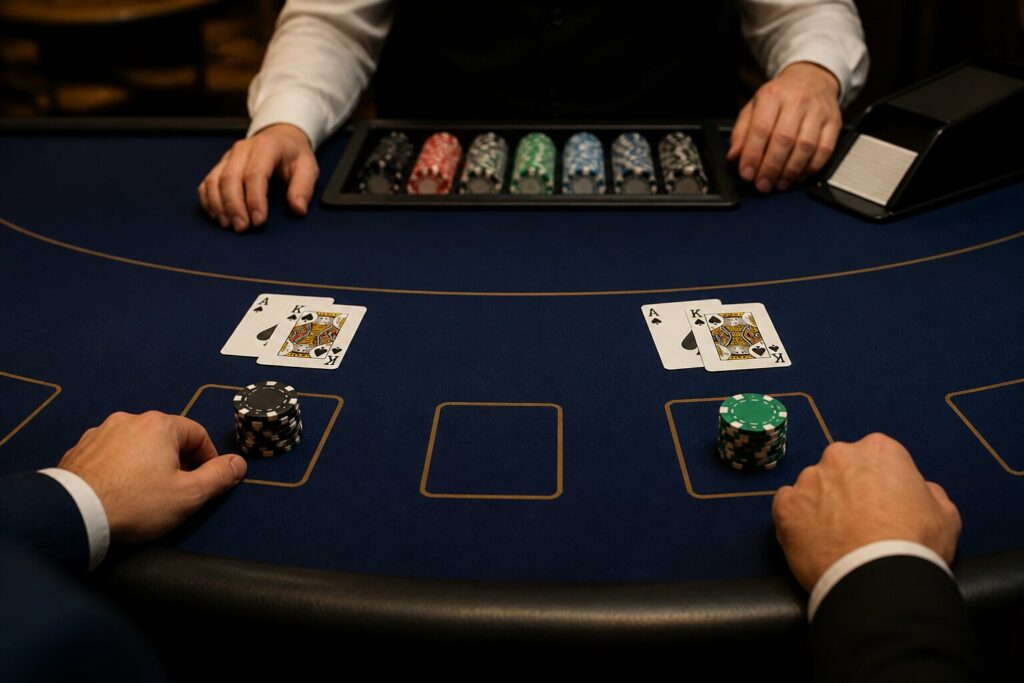
What Happens If 2 Players Get 21 in Blackjack? Split Pot and Payout Rules
Blackjack is one of the most engaging casino games. The objective is straightforward: reach a total as close to 21 as possible without going over.
If two or more players hit 21 in the same round, questions about payouts and who wins often follow. This article explains how those situations are settled, what counts as a natural blackjack versus a 21, and which rules determine whether you win, push or lose.
How Common Is a Tie With 21 in Blackjack?
A tie in which two or more players reach 21 in the same round is uncommon. Each player receives their own cards and makes independent choices, so outcomes are not linked across hands. Statistically, a player is dealt a natural blackjack—an Ace and a ten-value card as the first two cards—only a small portion of the time. For multiple players to have 21 in one deal, those probabilities must align, so the scenario is rare but within the realm of possibility, especially at a busy table.
Because every hand is dealt independently and resolved against the dealer, there is no reliable way to increase the chance of a tie. With that rarity in mind, the next section looks at what actually happens to bets when more than one player has 21.
Do Both Players Win If They Get 21?
Two players reaching 21 does not automatically mean both have won. Each player’s bet is settled against the dealer’s final hand rather than against other players. If the dealer’s hand is lower than 21, any player with 21 will be paid according to the table’s payout rules. If the dealer also has 21, the result for each player depends on whether those 21s are natural blackjacks or totals made with additional cards.
When the dealer has a natural blackjack, only players with a natural blackjack push and have their stakes returned; players with 21 from more than two cards normally lose. If the dealer’s 21 is not a natural blackjack, players with 21 usually push with the dealer and get their bets back. The next section explains how payouts differ between natural blackjack and 21 made with extra cards.
Who Gets Paid When Multiple Players Have 21?
When several players reach 21 in the same round, each hand is evaluated and paid independently against the dealer. There is no shared pool or split pot among players; the house settles each wager on its own merits.
A natural blackjack, an Ace with a ten-value card as the initial two cards, is typically paid at a higher rate than a 21 achieved with three or more cards. Many venues pay 3 to 2 for a natural blackjack while paying even money for a 21 made with extra cards. If multiple players hold natural blackjacks and the dealer does not, each of those players receives the enhanced blackjack payout. If a player’s 21 comes from more than two cards, they will normally receive even money provided the dealer’s total is lower.
House rules can tweak these payments, so after reading how payouts work, it is useful to understand how dealers actually resolve hands at the table.
How Dealers Resolve Split Pots in Blackjack
The concept of a split pot among players does not apply in blackjack. Dealers resolve each position one at a time by comparing that player’s hand to the dealer’s final hand. The key distinctions are whether the hand is a natural blackjack or a 21 formed from additional cards and whether the dealer’s final total beats, ties or falls below each player’s total.
If the dealer has a natural blackjack, players without a natural blackjack lose their bets, while those with matching naturals push. If the dealer’s 21 consists of three or more cards, any player with 21 will usually push and have their stake returned. Because procedures vary, it pays to be familiar with the specific rules in use at the table you are playing on. With those settlement mechanics clear, the following section looks at how house rule variations can affect outcomes.
House Rules Variations Affecting Tied 21 Outcomes
Operators may adopt subtle differences in payout rates or ranking, and these choices affect how tied 21s are handled. The most common distinction is the priority given to a natural blackjack over other 21s. Where that priority exists, a dealer natural generally beats a non-natural player 21. Other variations include different blackjack payout ratios and special conditions for certain game formats.
These rule differences are normally published with the game information, and dealers follow them consistently to ensure the outcome is transparent for every player at the table. Having covered typical variations, the article next considers how often multiple players might reach 21 in a single deal.
Can More Than Two Players Achieve 21 At Once?
Yes, more than two players can reach 21 in the same deal, particularly at tables with many seats. Each player’s hand is dealt and played independently, so several players may each end up with 21 by standing on different combinations of cards. When that happens, every player’s result is still compared individually with the dealer’s finished hand.
If three, four or more players have 21 simultaneously, the settlement process does not change. Each position is resolved separately against the dealer according to the house rules, meaning individual bets are either paid, pushed or lost based on the dealer’s final total.
Payouts are calculated per player rather than as a group result, so one player can win while another pushes or loses on the same round. This applies whether the players have 21 through a natural blackjack or by drawing to 21 during play, subject to the casino’s rules for blackjack payouts and qualifying hands.
The same principles apply regardless of table size or number of participants. The next section describes what occurs when the dealer also finishes with 21.
What If the Dealer Has 21 Too?
When the dealer also has 21, outcomes for every player are resolved by comparing each player’s hand to the dealer’s. There is no collective outcome for the table; each bet is handled separately. Players whose hands beat the dealer are paid according to the game’s payout rules, while those who tie push and have their original stakes returned, and those whose hands lose forfeit their wagers.
Any side bets or optional wagers are settled independently of the main hand unless the specific game rules state otherwise. Insurance bets, where offered, are also resolved according to their own conditions and are not automatically affected by the main-hand resolution.
Players and Dealer All Have Blackjack
If both a player and the dealer have natural blackjacks, that player’s round is a push and their original stake is returned. The same applies to any other player at the table who also has a natural blackjack. Players who do not have a natural blackjack will typically lose when the dealer’s blackjack is natural, unless the rules for a particular game state otherwise.
Different casinos may treat the timing of blackjack checks slightly differently, such as when the dealer looks for an ace or ten-value card. These procedural differences do not change the basic outcome: equal naturals push, and the stake is returned.
Players Have 21, Dealer Has 21 (Not Blackjack)
If both the dealer and player reach 21 by using three or more cards, the usual outcome is a push, with the player’s stake returned. This is the common rule at most tables, but some operators may apply different rankings or payouts for hands that reach 21 in different ways.
Operators that apply different rankings or payouts will specify these in their rules, so it is sensible to check the game terms before taking a seat. With the mechanics of dealer ties explained, the next section dispels common misunderstandings about tied 21s.
No Special Jackpots for Tied 21s
A common misconception is that a tie of 21s across the table triggers a special jackpot or bonus. In standard play, no such shared prize exists. Every wager is settled against the dealer on its own terms, and payouts follow the established rules for natural blackjack versus other 21s.
Difference With Dealer Blackjack
Natural blackjack holds priority over a 21 made with additional cards in most rule sets. That means when the dealer has a natural blackjack, only players with matching naturals will push; other players with 21 will not win that round. Clear rule displays and dealer procedures ensure these distinctions are applied consistently at the table.
Importance of Responsible Gambling
Betting should always be a considered activity. Outcomes are determined by the game’s rules and the independent dealing of cards, not by patterns or streaks. Set personal limits, understand the rules at the table, and step away if play stops being enjoyable or causes stress.
This explanation should help you recognise how multiple 21s are handled, what payouts to expect, and why the dealer’s hand is the deciding factor for each individual bet.
**The information provided in this blog is intended for educational purposes and should not be construed as betting advice or a guarantee of success. Always gamble responsibly.