French Roulette – Rules, Wheel Layout & How To Play: What Are the Key Features?
Ever wondered why some players prefer French Roulette when European and American versions are so widely available? The answer lies in a few distinct features: an elegant layout, French betting terms and rules that can slightly alter the payoff on certain wagers.
Beyond the single-zero wheel layout and the familiar spinning wheel, French Roulette includes specialised betting options and table elements that give it a character of its own. For many players these subtleties are what turn a routine spin into something more considered and strategic.
Before placing a stake, it helps to understand those differences and how they affect play. The next section explains the core contrasts with other roulette variants and why they matter.
How Does French Roulette Differ from Other Versions?
French Roulette shares the single-zero wheel layout with European Roulette, using 37 pockets numbered 0 to 36. American Roulette differs by adding a double zero, increasing the house advantage. That basic layout is only the starting point for what makes French Roulette distinctive.
Two rules commonly seen on French tables – La Partage and En Prison – change the treatment of even-money bets when the ball lands on zero. La Partage returns half the stake on those bets, while En Prison leaves the stake in play for the next spin. These options reduce the effective house edge on even-money wagers compared with tables that lack them.
Terminology and table layout also set the game apart. French names such as Manque and Passe appear across the betting area, and a racetrack-shaped betting strip mirrors the wheel, enabling wheel-position bets. With these features combined, the game offers a slightly different risk profile and a distinct pace. To see how those wheel positions translate into betting possibilities, next we look at the wheel layout itself.
Understanding the French Roulette Wheel Layout
The French wheel uses 37 pockets, with the single zero placed in green and numbers 1 to 36 alternating in red and black. The sequence on the rim is not numerical but arranged to distribute high and low numbers, reds and blacks, and odds and evens so clusters of similar outcomes are minimised.
That arrangement influences the racetrack bets, because those call bets are based on where numbers sit around the wheel rather than on the numerical grid. For instance, groups such as Voisins du Zéro gather numbers physically close to zero on the rim, while Tiers du Cylindre covers roughly the opposite segment.
On the table, the main number grid sits alongside the racetrack, and the wheel’s balance makes the racetrack meaningful for players who prefer bets tied to wheel position rather than simple number groups. With the wheel and racetrack understood, it is easier to grasp the specific rules that affect certain bet types.
Key Rules Every Player Should Know
French Roulette follows standard payouts for straight-up, split, street and other conventional bets, but the handling of even-money bets is where rules differ. La Partage means an even-money bet loses only half if the ball lands on zero, while En Prison holds the stake for one further spin and returns it if that follow-up spin wins. Both rules reduce the effective house edge on even-money bets compared with tables that do not offer them.
The single zero itself gives the house an advantage, yet these rules moderate its impact on specific bets, creating a distinct balance between risk and reward. French terminology labels even-money bets as Pair/Impair and Rouge/Noir, and the racetrack calls allow players to target wheel sectors rather than just numbers on the grid.
Keeping play within personal limits is a sensible part of enjoying the game; understanding how rules like La Partage and En Prison function helps players make clearer choices about which bets to place. The next section explains how those choices are reflected in the table layout.
French Roulette Table Features Explained
A French Roulette table centres on the three-by-twelve number grid with the single zero set slightly apart at the top. Outside bets such as Manque (1-18), Passe (19-36), Pair (even) and Impair (odd) are arranged around the grid and marked in French, making it simple to find and compare options at a glance.
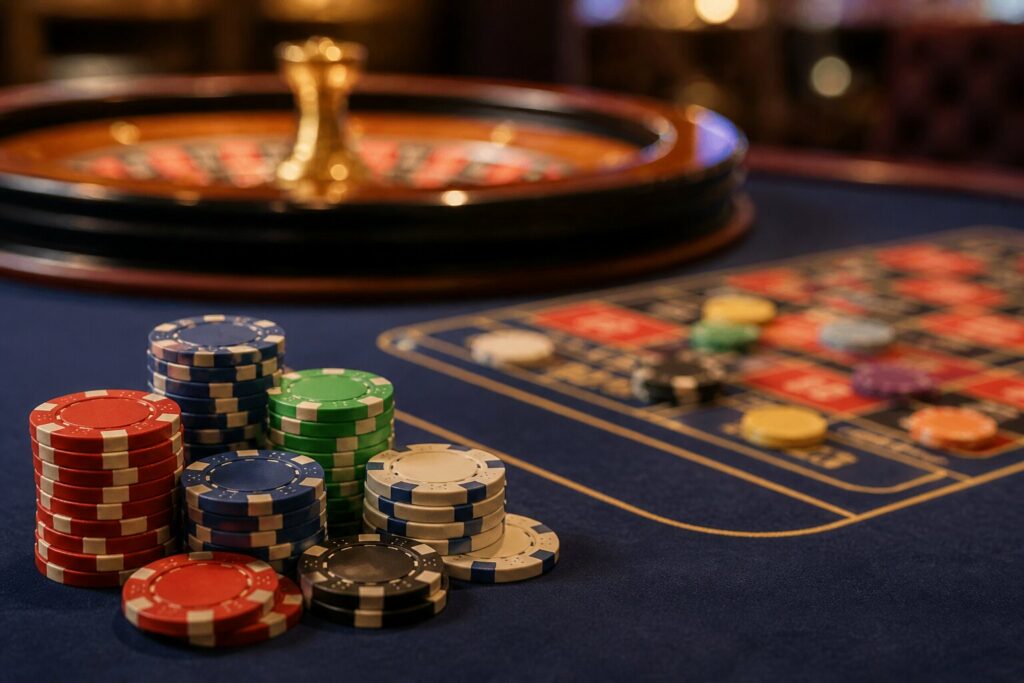
Adjacent to the main betting area sits the racetrack, a narrow oval that mirrors the wheel’s rim and is used for call bets linked to wheel position. Voisins du Zéro, Tiers du Cylindre and Orphelins are the most common of these – each name specifies a group of pockets as they appear around the wheel rather than on the numerical table. Chips placed on the racetrack represent those specialised wagers.
This layout encourages a mix of conventional grid betting and wheel-based strategies, and the visual separation helps players decide whether to focus on number clusters or on the broader sectors offered by the racetrack. With the table and racetrack in view, the French terms used for bets make much more sense; the next section defines those terms and the principal wager types in detail.
Essential French Terms & Betting Options
Below are the main bet types and commonly used French terms, presented so the table makes immediate sense.
What Are the Main French Roulette Bets?
- En Plein (Straight Up): A bet on a single number.
- A Cheval (Split): A bet covering two adjacent numbers; placed on the line between them.
- Transversale Pleine (Street): A bet on a row of three numbers.
- Carré (Corner/Square): A bet covering four numbers in a square.
- Sixain (Six Line/Double Street): A bet on six numbers spanning two adjacent rows.
- Colonne (Column): A bet on one of the three vertical columns of twelve numbers.
- Douzaine (Dozen): A bet on one of the three groups of twelve numbers (1-12, 13-24, 25-36).
What Do the Table Terms Mean?
- Manque – 1-18 (low numbers)
- Passe – 19-36 (high numbers)
- Pair – Even numbers
- Impair – Odd numbers
- Rouge – Red
- Noir – Black
- Voisins du Zéro – Neighbours of Zero, covering numbers close to zero on the wheel
- Tiers du Cylindre – Thirds of the Wheel, covering roughly one third of the rim opposite zero
- Orphelins – Orphans, numbers not included in Voisins or Tiers
These labels connect the visual table and the physical wheel, allowing players to choose bets by number, by position on the rim, or by simple outside categories. Having these terms in mind makes the process of placing wagers and interpreting the racetrack much clearer, which leads naturally into how a round of French Roulette plays out.
How To Play French Roulette: Step-by-Step
A round of French Roulette unfolds as a cycle of betting, the wheel spin and the resolution of wagers. Chips of fixed values represent stakes and are placed on the table’s number grid, on outside areas such as Manque or Passe, or on the racetrack for wheel-position bets. Bets may cover a single number, multiple numbers, a column or a sector of the wheel.
When the croupier spins the wheel and launches the ball, the outcome is determined as the ball comes to rest in one of the pockets. Winning bets are paid according to standard roulette odds for their type, while losing bets are removed. If the ball lands on zero and an even-money bet is affected, the table’s rule – La Partage or En Prison – determines whether half the stake is returned or the stake remains for the next spin. Winnings are settled and the table is cleared for the next round.
Understanding how bets map to the wheel and how the special rules apply helps a player interpret results and choose future wagers more deliberately. With the table features, wheel layout and rules now clear, the game’s structure should feel logical and easier to navigate.
Explore Casino Games at King Casino
Ever wondered what it is like to be part of our community at King Casino? We invite you to enjoy all the excitement and fun our site has to offer whenever you fancy a bit of entertainment.
Getting started is simple: just create your account, make a deposit and you’re all set to play. We look forward to welcoming you at King Casino.
**The information provided in this blog is intended for educational purposes and should not be construed as betting advice or a guarantee of success. Always gamble responsibly.