
Do Slot Machines Emit Blue Light? Myths vs Reality Explained
Have you ever heard someone say that slot machines use blue light to keep players hooked? You are not alone—this claim circulates widely online and in conversations around casinos.
It can be hard to separate speculation from science, so this article walks through what blue light is, how slot machines produce light, and what research tells us about any health implications. Read on to get a clear picture and straightforward guidance on managing screen exposure while playing.
Understanding Blue Light: What Is It and Where Does It Come From?
Blue light sits toward the short-wavelength end of the visible spectrum and therefore carries more energy than red or yellow light. Sunlight is the main natural source, but many everyday devices also emit blue light: televisions, phones, tablets and computer monitors all produce it as part of their normal operation. Modern lighting such as LEDs and some fluorescents contributes too.
Scientists pay attention to blue light because it can interfere with sleep when people have prolonged exposure in the evening; the mechanism involves suppression of melatonin, a hormone that helps regulate sleep-wake cycles. Blue light also plays a role in visual clarity and colour rendering, which is why manufacturers use it in displays. Understanding these basic properties makes it easier to judge claims about any one device type, and sets up a closer look at slot machines themselves.
Do Slot Machines Emit Significant Blue Light?
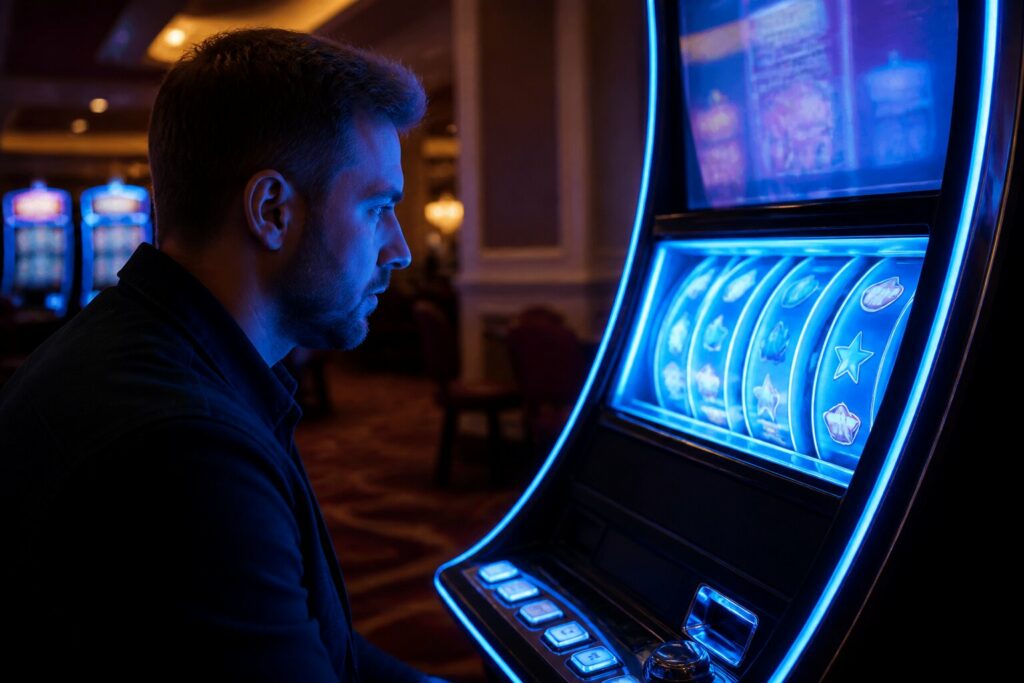
Slot machines use combinations of LCD or LED displays, backlighting and coloured panels to produce bright, attention-getting visuals. Those technologies naturally emit blue wavelengths as part of producing full-colour images, so slot machines do give off some blue light, much like a television or arcade screen.
The key point is that the amount is not exceptional. Design goals for a machine emphasise clear graphics and contrast rather than intensified blue emission. Manufacturers also follow safety and electrical standards that govern screen brightness for indoor environments. So while a slot machine will contribute to a room’s overall light, it is not emitting unusually high or uniquely harmful levels of blue light when compared with other electronic displays.
Common Myths About Slot Machines and Blue Light
There are two persistent misconceptions: that slot machines are deliberately lighting players in a way that alters behaviour, and that their blue light is a distinct hazard.
First, lighting is used to attract attention and highlight wins, but that is not the same as an engineered attempt to manipulate players via spectral content. Regulatory frameworks and industry testing focus on fairness and player protection, and do not support the idea that blue wavelengths are deployed to control decisions.
Second, claims that blue light from slot machines is more dangerous than that from other screens are not backed by evidence. The spectral profiles of LEDs in consumer electronics are similar across device types, so the risks and effects—chiefly eye strain from extended viewing and potential sleep disruption in the evening—track with duration of exposure rather than the specific device.
This leads naturally into what researchers have actually observed about blue light and health, and what that means for people who spend time in gaming areas.
Effects of Blue Light on Health: Fact or Fiction?
Research into blue light focuses largely on its influence on sleep patterns and short-term visual comfort. Studies indicate that evening exposure to bright blue-rich light can shift circadian rhythms by reducing melatonin production, which may delay sleep onset. For people with irregular sleep schedules or who play late into the night, this is the primary concern.
Eye irritation and tiredness from looking at screens for long periods are well documented, but these issues are associated with prolonged viewing and poor ergonomics rather than unique properties of blue light alone. For healthy adults there is no solid evidence linking typical exposure from consumer screens to long-term eye damage.
Practical examples clarify this: watching a two-hour film on a television or using a tablet for the same length of time is likely to produce comparable effects on alertness and eye strain to a similar period spent at a slot machine. The deciding factors are session length, ambient lighting and proximity to the screen.
With that context, it makes sense to compare the lighting characteristics of slot machines with familiar household devices.
Slot Machine Lighting Compared to Other Electronic Devices
Technically, slot screens and common devices share the same display families: LED, LCD and sometimes OLED panels. All these technologies use blue-emitting diodes or subpixels to render bright, crisp images. As a result, the spectral output and peak wavelengths overlap considerably.
Differences that do exist tend to come down to brightness settings, viewing distance and the use of accent lighting around the machine. Gaming areas can be dimmer than typical living rooms, which makes bright screens appear more intense; the visual contrast can heighten the sense of brightness, even though the spectral composition remains similar to other screens. Manufacturers must meet safety and electromagnetic standards, which helps keep emissions within normal ranges for indoor electronics.
Understanding these parallels helps when considering practical ways to reduce exposure without losing enjoyment of the game.
How to Minimise Potential Blue Light Exposure While Gambling
Reducing exposure is mostly about habits and environment. Short, regular breaks away from screens reduce eye strain and give the body a chance to reset its visual focus. Stepping into a well-lit area for a few minutes or shifting attention to a distant object relaxes the eye muscles and lowers cumulative screen time.
Many modern devices offer settings that reduce blue-emitting wavelengths in the evening, sometimes labelled as night mode or blue-light reduction. Adjusting screen brightness and increasing ambient room lighting to reduce contrast between the display and surroundings can also ease visual fatigue. Keeping sessions to planned durations and mixing other activities into an outing creates natural pauses and prevents long, uninterrupted exposure.
These measures are straightforward and apply equally to playing at a machine, on a tablet or watching television.
Conclusion: Separating Myth from Science
The evidence shows that slot machines do emit blue light because they use the same display technologies found in other electronics, but they are not a unique or especially hazardous source. The main considerations are how long someone is exposed and the lighting conditions around the device, rather than the fact of blue light itself.
Practical steps such as taking breaks, moderating session length and using screen settings in the evening help manage any potential effects on sleep and eye comfort. Keeping play within self-set limits and balancing it with other activities supports wellbeing while allowing people to enjoy gaming as entertainment. This balanced approach gives you clear, usable guidance without exaggeration, so you can decide what feels right for your own habits.
**The information provided in this blog is intended for educational purposes and should not be construed as betting advice or a guarantee of success. Always gamble responsibly.