
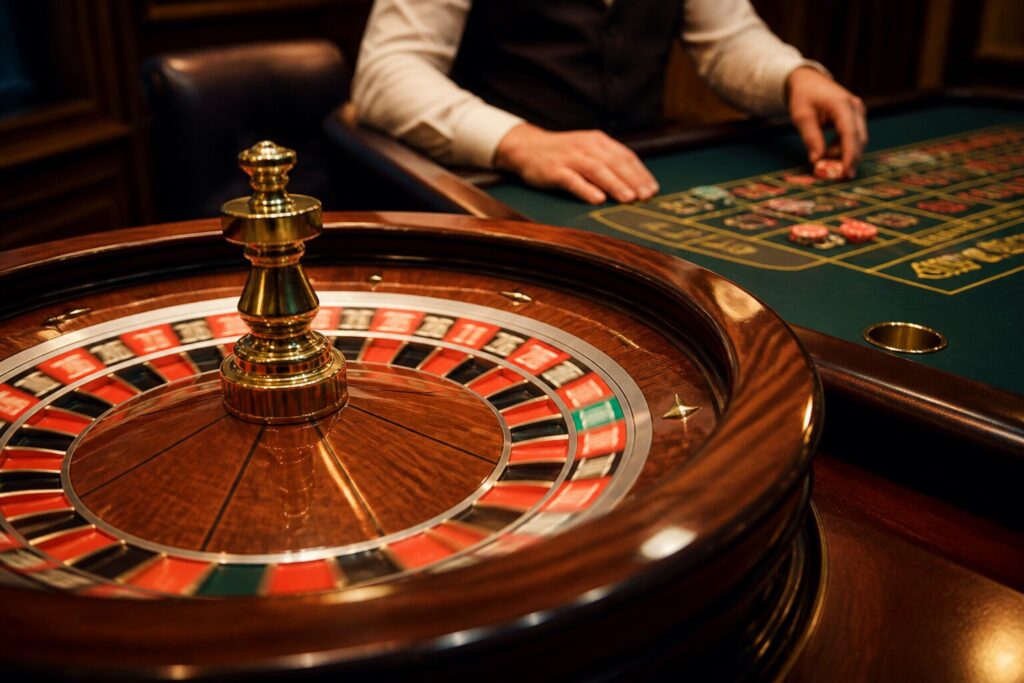
Roulette House Edge Explained: Can You Reduce The Casino Advantage?
Ever wondered why the casino always seems to come out on top at the house edge wheel? You’ve probably heard the phrase ‘house edge’, but what does that actually mean and can a player do anything about it?
Understanding the house edge helps you make better choices at the table and sets realistic expectations about outcomes. This guide explains how the advantage arises, compares different roulette wheel types, and looks at the common ideas players use to try to change the odds.
Ready to find out what the numbers really tell you about the spin? Let’s get started.
What Is The House Edge In Roulette?
The house edge in roulette expresses the casino’s long-term advantage over players as a percentage of stakes. It comes from the game’s design and the way payouts relate to the true odds, not from any player skill.
Put simply, the house edge shows the average amount the casino expects to keep from each bet over many plays. For example, a 2.7% house edge means that, on average, the casino will retain about £2.70 for every £100 wagered across a large number of spins. This figure applies over time and many rounds; short-term results can vary widely.
That advantage is built into the wheel itself. The extra green pocket or pockets – zero and sometimes double zero – create outcomes where certain bets lose even though they appear to cover half or a large share of the numbers. The mathematics behind that mismatch between payout and true odds is what produces the house edge.
How Is Roulette House Edge Calculated?
The house edge is calculated by comparing the true probability of a winning outcome with the payout offered by the casino. Any gap between the fair odds and the paid odds translates into a small percentage the casino expects to keep over time.
In European roulette, for instance, there are 37 pockets (numbers 1–36 plus a single zero). A straight-up bet on one number wins once in 37 spins on average. The payout is 35 to 1, but true even-money compensation for that probability would be 36 to 1. That missing unit in the payout creates the edge.
This is a statistical concept rather than an observable change in a single spin. Over many spins the small disadvantage on every bet accumulates into the house edge percentage.
Worked Example: Expected Loss On A £10 Bet
To make the maths clearer, imagine placing a £10 straight-up bet on a single number in European roulette.
Chance of winning: 1 in 37
Payout if you win: £350 (35 to 1, plus your £10 stake returned)
If the same £10 bet were repeated 37 times, the expectation is roughly one win and 36 losses.
Total staked: £370 (£10 × 37)
Total returned when the one win occurs: £350
Over those 37 bets, the expected net loss is £20, which equals about 2.7% of the total staked. That percentage is the house edge for standard European roulette and reflects the average loss across many plays.
How The Zero Affects The Casino Advantage
The green zero pocket changes the balance of outcomes on the wheel. Without it, many bets would pay out at fair odds and neither side would have a systematic edge. With the zero, however, there is an extra outcome that causes certain bets to lose.
Take an even-money bet such as red. In European roulette, there are 18 red numbers and 18 black numbers, plus the single green zero. If you bet on red, a spin landing on zero means you lose, even though the bet covers half the numbered pockets. That single extra outcome shifts the overall math slightly in the casino’s favour.
Viewed across many spins, those extra losing outcomes created by zero are precisely how the house edge emerges. The single zero produces a smaller edge than two zeros, but it is nonetheless what gives the casino a built-in advantage.
European, American And French Roulette Compared: Which Has The Lowest Edge?
The number and treatment of zero pockets determine the common house-edge differences between roulette variants.
European roulette uses a single zero and typically has a house edge of about 2.7%. American roulette adds a double zero, increasing the pockets to 38 and raising the house edge to roughly 5.26%. That extra green pocket makes a substantial difference to the long-term expected return.
French roulette commonly uses a single zero but may include special rules such as La Partage or En Prison on even-money bets. Those rules reduce the effective house edge on qualifying bets and can lower it to around 1.35% for those specific wagers. Otherwise, French roulette without those rules follows the same 2.7% figure as European roulette.
If comparing tables, look at whether special rules apply and how many zero pockets are present; these are the clear, measurable factors that change the maths in a player’s favour or against it.
What Are La Partage And En Prison And Do They Reduce The Edge?
La Partage and En Prison are rules that alter the treatment of even-money bets when the ball lands on zero, and both reduce the house edge on those bets.
Under La Partage, an even-money stake is halved if zero appears, so the player loses only half the wager instead of the whole amount. En Prison leaves the original stake on the table for the next spin; if the subsequent spin wins, the stake is returned without additional winnings, while a loss on the next spin forfeit the stake. Both mechanisms lessen the average loss on even-money bets.
These rules do not reverse the house advantage, but they do cut the edge roughly in half on the affected bets, which is why some players favour French roulette tables that apply them. It is important to check table rules before playing, so you understand how zero is treated and what impact that has on your expected return.
Which Bets Offer The Lowest House Edge?
On standard European or American tables, the house edge is essentially the same across bet types, because the payout structure is scaled to the same underlying odds. That means single-number bets, splits and even-money bets carry the same built-in percentage disadvantage within a given wheel type.
Where differences arise is when special rules are in effect. On French tables with La Partage or En Prison, even-money bets (for example red/black or odd/even) benefit from the reduced edge and therefore represent the lowest house-edge options available in roulette.
Knowing which tables apply those rules and selecting bets accordingly is how a player can choose lower-edge options, while still remembering that an edge remains and outcomes vary in the short term.
Can Betting Systems Reduce The House Edge?
Many betting systems adjust stake sizes after wins or losses, producing different patterns of short-term wins and losses. Common examples include progression systems where bets increase after defeats or following a sequence.
Such approaches change the distribution of wins and losses and can alter the volatility of a session, but they do not change the mathematical house edge. The built-in percentage advantage tied to the wheel and payout structure remains the same regardless of stake progression. Thus, over many spins the expected return for the player does not improve simply because stakes are varied according to a system.
A practical limitation of some systems is that they can require large bankrolls or encounter table limits that prevent continuing the pattern, which increases the risk of a significant loss before any recovery; this is why understanding the underlying edge is more useful than relying on staking systems.
Common Misconceptions About Roulette House Edge
There are a few recurring misconceptions that can affect how people approach roulette. Clearing these up helps set realistic expectations.
“Betting systems can beat the house” — Betting systems alter bet sizes and short-term outcomes but do not reduce the built-in house edge. Over many spins the same percentage disadvantage persists.
“Past spins affect future outcomes” — Each spin is a separate event; previous results do not change the probabilities on the next spin. Treating patterns as predictive can lead to incorrect decisions.
“Skill or patterns can change the house edge” — The house edge is a product of game rules and payouts. No player skill or observation can change those structural percentages.
Understanding these points keeps the focus on what is actually controllable: choosing tables with lower edges when available, managing stakes, and playing within means. That approach supports informed choices rather than chasing misconceptions.
**The information provided in this blog is intended for educational purposes and should not be construed as betting advice or a guarantee of success. Always gamble responsibly.