
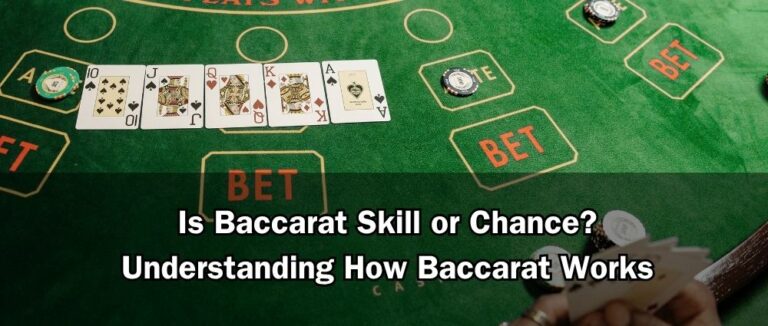
Is Baccarat Skill or Chance? Understanding How Baccarat Works
Baccarat is often seen as one of the most glamorous games in the casino, with its air of sophistication and suspense. But behind the elegant tables and crisp cards, many wonder whether it’s a game of pure chance or if skill has a part to play.
If you’ve ever watched a game of baccarat unfold, you’ll know how quickly it moves, and how easy it is to get swept up in the action. Is it just about choosing which side will win, or is there more to it?
Whether you’re completely new to baccarat or simply curious about what really goes on behind the scenes, this guide breaks it down in simple terms. We’ll look at how the game works, what affects the outcome, and whether strategies truly give you an edge.
How Does Baccarat Work?
Baccarat is straightforward to follow, which is a big part of its appeal. The game revolves around two hands, the Player and the Banker. You are not competing against other players; instead, you predict which hand will finish closest to a total of nine, or whether the round will end in a tie.
To begin, place a bet on the Player, the Banker, or a Tie. Two cards are then dealt to both the Player and the Banker. You are betting on the outcome rather than controlling the cards, and you cannot influence how the hands are played once your wager is placed.
Card values are added using fixed rules: cards 2 to 9 are worth their face value, 10s and picture cards (J, Q, K) count as zero, and Aces count as one. Only the last digit of the total matters, so a hand totalling 14 counts as 4.
If either hand totals eight or nine, this is called a “natural” and no more cards are drawn. Otherwise, pre-set drawing rules determine whether a third card is taken. You do not make any further decisions after betting, as the dealer follows these rules automatically.
When both hands are complete, the one closest to nine wins. Bets on that outcome are paid accordingly. In many games, Player bets pay 1:1, while Banker bets usually pay 1:1 with a commission (often 5%) or an adjusted payout; Tie bets pay more but occur less frequently. Payouts and house edge can vary by table and variant, so always check the displayed rules before you play.
All outcomes are based on chance. There is no strategy that can guarantee a return, and past results do not predict future results. Treat baccarat as entertainment, set affordable limits, and only stake what you can comfortably afford to lose.
Main Bets And Payouts
In baccarat, there are three main bets you can place: Player, Banker, and Tie. Each has its own payout and house edge, and these can vary by table or operator. Always check the paytable and rules in advance.
A successful Player bet pays even money. For example, a £10 stake returns £20 in total (£10 profit plus your £10 stake). If the result is a Tie and you backed Player, the bet usually pushes, meaning your stake is returned with no win or loss.
A winning Banker bet also pays even money, but a 5% commission is typically taken from your winnings because, under standard drawing rules, the Banker hand has a slightly higher chance of winning. For instance, a £10 Banker win pays £9 profit after commission, for a £19 total return. Some versions use alternative commission structures (such as adjusted payouts on specific results), so confirm how your table handles Banker wins.
A Tie bet pays more, commonly 8 to 1 or sometimes 9 to 1. Using the same £10 stake, an 8:1 payout returns £90 in total, while 9:1 would return £100 in total. However, Tie outcomes occur far less frequently and the associated house edge is usually higher than for Player or Banker.
Because Player and Banker generally carry a lower house edge, the expected loss per pound wagered is typically lower than on Tie. Outcomes are still random and never guaranteed, and short‑term results can differ significantly from expectations. Bet sizes, limits, and any fees or side bets can also affect your experience, so set sensible limits and only gamble with funds you can afford to lose.
Now that the bet types and payouts are clear, it helps to know how hand totals are calculated and why the drawing rules matter, as these underpin the probabilities behind each bet.
Card Values And Drawing Rules
Card values in baccarat are straightforward. Cards 2 to 9 count as their number. Tens, Jacks, Queens and Kings are worth zero. Aces count as one.
Only the last digit of the total matters, so if a hand adds up to 14, its value is 4. Another example: 7 plus 8 totals 15, which counts as 5. This “modulo 10” approach is used for every hand.
Two cards are dealt to each hand. A total of 8 or 9 is a natural, which ends the round immediately with no further cards drawn. Naturals can occur for either the Player hand or the Banker hand.
If there is no natural, fixed rules decide whether a third card is drawn. The Player hand acts first. If the Player total is 0 to 5, a third card is drawn. If the Player has 6 or 7, the Player stands.
The Banker’s action then depends on the Banker’s total and, in many cases, on the Player’s third card. As a guide, the Banker typically draws on totals of 0 to 2, and will stand on 7. For totals of 3 to 6, whether the Banker draws or stands depends on the specific value of the Player’s third card.
These procedures are automatic at the table and are applied consistently by the dealer or system, so there is nothing for you to calculate or decide during play. You can simply observe the dealing sequence and the totals.
Understanding these rules helps you follow what is happening in real time. Outcomes are determined by the cards dealt and chance, and no strategy can influence the drawing sequence or remove the house edge.
If you choose to play, set limits, avoid chasing losses, and only stake what you can afford to lose. Baccarat is a game of chance, and results cannot be predicted or guaranteed.
Is Baccarat Skill Or Chance?
Baccarat is primarily a game of chance. You place a wager on the Player, Banker, or Tie, and the outcome is determined by the cards dealt and the fixed third‑card drawing rules. Once your bet is down, there are no in‑play choices that let you influence how the hand unfolds.
The result of each round is driven by the random order of cards in the shoe and the pre‑set procedure for drawing. The aim is simply to back the hand that finishes closest to a total of nine; you do not make tactical moves during the deal itself.
Because the rules are predetermined, no technique can consistently overcome the house edge built into the bets. Each round is independent of the last, so past sequences do not make any particular outcome more or less likely next time. Streaks can occur, but they do not change the underlying probabilities.
Betting systems that increase or decrease stakes after wins or losses cannot alter the odds. They may change how your bankroll rises or falls in the short term, but they do not provide a reliable advantage. Typical house edges are around 1–1.5% on Banker and Player bets (depending on rules and commission), while Tie and many side bets carry a significantly higher house edge, making them riskier.
If you enjoy games where tactical choices during play make a meaningful difference, baccarat may feel quite straightforward. If you prefer a quick, clear game where outcomes are settled fast and the key decision is which bet to make, baccarat fits the bill and is easy to follow for newcomers.
Always play within your means, set limits, and remember that outcomes are never guaranteed. Odds and returns can vary by variant and venue, so check the specific rules before you play and only gamble if you are legally permitted to do so.
Are There Any Skills That Can Influence Outcomes?
Baccarat is famously streamlined, and the key decisions are locked in by the rules, leaving very little room for strategic influence. Outcomes are driven by chance, not player skill, and no betting system can change the built‑in house edge.
That said, understanding the bet types and the house edge can help you make more informed choices about where to place your chips and how to pace your session. In general, Banker and Player wagers carry a lower house edge than Tie bets, but this affects expected results only over the long term and never guarantees a win on any given hand.
It can also be helpful to view baccarat as entertainment rather than a way to make money. Consider setting time and spend limits, taking regular breaks, and deciding in advance how you will handle a winning or losing run. These steps support responsible play but do not influence the probability of future outcomes.
Some players look for rule variations, such as commission‑free versions where Banker wins on certain totals pay differently. These variants shift payouts and the house edge slightly, so checking the table rules before you sit down is sensible, especially if side bets are offered with different risks.
Bankroll planning can help you set expectations and manage how long you play, though it does not change the probability of winning any given hand. Spreading wagers, adjusting stake sizes, or changing tables may alter volatility and session length, but the house advantage remains in place regardless of approach.
Card Counting And Edge Sorting: Do They Work?
Card counting is effective in blackjack because player decisions can react to the remaining deck composition. In baccarat, the fixed drawing rules and typical dealing procedures, including multiple decks and cut‑card placement, greatly limit any practical benefit from tracking exposed cards.
Even highly skilled counters would see negligible effect on outcomes under standard conditions. Past results do not predict future hands, and attempting to gain an advantage through counting may lead to enhanced game protection without improving your expected return.
Edge sorting relies on spotting tiny manufacturing differences on card backs to identify certain values. Aside from being against casino rules, modern card handling and surveillance make it unrealistic in regular play, and attempting it can result in refusal of service.
Well‑publicised cases have led to disputes and voided results, which underlines that it is neither reliable nor acceptable. The only sustainable approach is fair, responsible play within your limits, recognising that every hand is a game of chance and outcomes cannot be controlled.
Practical Expectations For Players
Go into baccarat with clear, realistic expectations. It is a game of chance with a built‑in house edge, and outcomes are not within your control. There is no guaranteed way to win, and no system or staking approach can change the underlying odds.
Each round is independent. Streaks can and do occur, but they arise from random variation rather than a pattern you can predict or exploit. Treat the game as entertainment, and view any winnings as a welcome outcome rather than something to rely on.
Set a budget in advance and decide how you will pace your play. Keep sessions comfortable, take regular breaks, and avoid chasing losses. Only stake what you can afford to lose, and consider setting limits before you start so your plan is easier to follow in the moment.
Licensed operators provide tools such as deposit limits, reality checks, time‑outs and self‑exclusion. Use these features if you need them, and seek support if gambling stops being enjoyable or starts to feel like a problem. Help is available and taking a break is always a sensible choice.
With the rules understood and expectations set, baccarat is a straightforward, fast game where the interest lies in choosing your bet and watching the totals land. Different bets carry different odds and return to player values, and side bets usually come with a higher house edge, so factor that into your decisions.
Play for enjoyment, take your time, and remember you can stop at any point. That clarity and simplicity are key reasons so many players return to the table for the experience, not as a way to make money.
**The information provided in this blog is intended for educational purposes and should not be construed as betting advice or a guarantee of success. Always gamble responsibly.